Severe depression
The Woman in the WindowSevere depression shapes Anna Fox’s experience of time, domestic space, treatment, and bereavement. The novel presents it not as a single episode with a neat boundary, but through extended withdrawal, compromised self-care, and a shifting relationship to the dead. Anna can recognize some of the risks she faces and, at moments, acknowledge the loss directly; recognition does not immediately end the habits or inner conversations through which she lives with it.
Course and Domestic Withdrawal
After her family leaves, Anna describes months in which she can scarcely get herself out of bed. Her movements are reduced to rolling from one end of the mattress to the other, the bedclothes winding and unwinding around her. The confined routine gives the depression a physical scale: a large part of her world contracts to the bed, and even movement within it becomes slow and limited.
The upper floor carries a different measure of that withdrawal. Olivia’s bedroom remains present in the house, but Anna’s access to it is intermittent. Some nights she goes there as though haunting the room; on some days she stands at its doorway, while whole weeks pass without her visiting the floor. The longer absence makes the room seem to recede into memory. Her depression is therefore registered not only as inactivity, but as an uneven capacity to approach a place bound to her daughter.
The family loss is not the only pressure surrounding this period. Ten days before Anna looks back on the beginning of the separation, Ed had decided that they should separate and Anna had agreed in principle. She had not believed it would actually happen, even when he summoned a broker. The account situates the marital rupture alongside her withdrawal without reducing the depression to that decision alone. In a recollection of their time in Vermont the previous December, she remembers the family travelling with Olivia, while later memories of Ed and their daughter retain tenderness as well as pain.
Treatment, Knowledge, and Alcohol
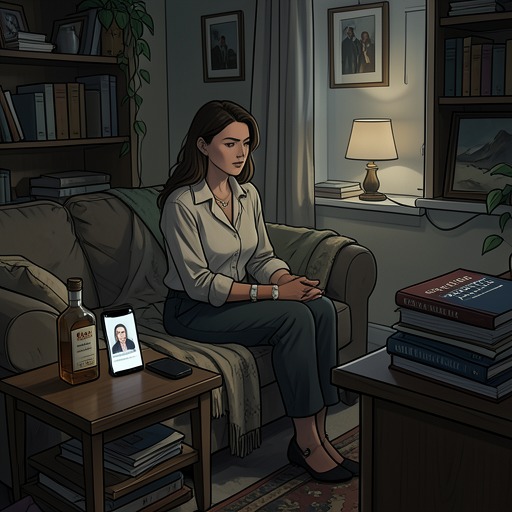
Anna understands that alcohol is a depressant and that it is ill-suited to someone experiencing depression. She has professional knowledge as well: she coauthored work on adolescent depression and alcohol abuse with Wesley Brill. Yet she describes taking her medication with merlot and says she has been combining them for almost a year. Her awareness of the danger coexists with continued use; knowledge does not, by itself, interrupt the pattern.
Her self-assurance about that pattern is undercut by a later accounting of what she has consumed. In the living room, she finds two drained wine bottles and four canisters of pills, recognizes that the wine amounts to two bottles plus what she drank at lunchtime, and admits that it is a great deal. She also questions whether she took the correct medication and quantity that morning, noting that she has been careless. The scene links drinking and medication management to uncertainty about her own care, while her belief that she can assess the situation contrasts with the evidence before her.
The strain also surfaces in an exchange with GrannyLizzie, Anna’s online support partner. GrannyLizzie reports that the day has been harder than the one before it. The reply Anna receives frames progress as uneven rather than steadily improving. That exchange offers a small but concrete counterpoint to isolation: Anna participates in a supportive online conversation, yet the difficult day remains difficult. The narrative does not present connection as a cure or recovery as a straight line.
Grief and the Continuing Presence of Family
When Val Norelli tells Anna that Ed and Olivia are dead, the statement breaks through her previous resistance. Anna acknowledges that they died and says she does not deny it. Dr. Julian Fielding nevertheless identifies denial as part of what is happening. The two positions remain together: Anna can assent to the fact of death while still experiencing the absence through a persistent inner presence.
She describes hearing the voices of Ed, Olivia, and other people when overwhelmed by loss, when she needs someone to talk to, and at unexpected moments. She responds to them. On a later birthday, while lying in bed, she hears Ed and Olivia greet her together; she also remembers that the birthday she assigned to Jane Russell is November 11. The remembered family greeting makes an ordinary calendar occasion a point where domestic intimacy and bereavement meet.
Olivia’s voice returns in another moment, asking Anna what she is going to do as Anna watches the Russell house across the park. Anna turns away and tries to redirect her attention to Jane. These episodes place the family’s voices within the ongoing texture of her life rather than presenting one final farewell. The novel’s emphasis is on the tension between knowing that the family has died and continuing to answer, remember, or seek their presence.
Perception and Uneven Change
Anna’s depression unfolds amid uncertainty about what she sees and hears, but the evidence does not establish that every unusual perception is caused by depression. At one point, a small glowing heart resolves into a vision of Jane, radiant and watching her. Elsewhere, Anna is challenged by a speaker who tells her that the matter is over and that she is making a mess of her life. Such moments place her vulnerable perspective under pressure without making a simple diagnosis of each experience.
The book likewise gives no uncomplicated recovery point for the depression in these passages. Anna’s awareness of her family’s deaths becomes explicit, but she continues to hear and answer them; her isolation, difficult days, drinking, and uncertainty about medication remain part of the account. Severe depression is thus represented through both the scale of what Anna cannot readily do and the persistence of attachments she cannot simply set aside. Her recognition of loss changes what she can admit, while the continuing voices show that acknowledgement and emotional release are not the same thing.